
Three Videos
Questioning the Role of Generative AI
in the Context of Art History
- The Treachery of Drifting Slop
- The Fountain of Drifting Slop
- The Soup of Drifting Slop
Drifting Slop is a series of videos and corresponding images that ask what happens to meaning when it passes through machines that don't understand it.
Starting with three works that already probe the gap between art and what it represents—René Magritte's The Treachery of Images (This is Not A Pipe), Marcel Duchamp's Fountain (a porcelain urinal he showed as a “readymreadymade” artw artwork), and one of Andy Warhol's Campbell's Soup Cans—the piece encourages two generative AI models to describe the works and collaborate on an exquisite-corpse-style exchange as we watch their outputs drift. With each pass, the original image evolves further, like a whispered phrase mutating around the circle in a game of telephone. A drift that might be seen as a metaphor for the cultural, social and economic shifts underway as a result of AI's spread,
The piece serves as a bridge between twentieth-century high art history and the current, gritty vernacular of “slop,” usually shorthand for AI’s digital slurry of glistening, homogenized mediocrity, and is often used to dismiss AI art outright. Here, that meaning shifts. Just as Magritte, Duchamp, and Warhol were once dismissed as jokes, this project takes “garbage” outputs—glitches, mistakes, middling sheen—and steers them toward images that might resonate more deeply on their own terms.
The resulting videos below are less a comment on art made using AI models than a provocation about what's gained and lost as these new tools reshape how images are made, seen, and valued. They also ponder what new art forms might emerge as artists learn to work through “slop,” embracing its glitches, and/or pushing past it entirely, toward something new.
This is not a pipe? This is not even an image. This is the byproduct of machines and humans collaborating on hallucinatory visions.
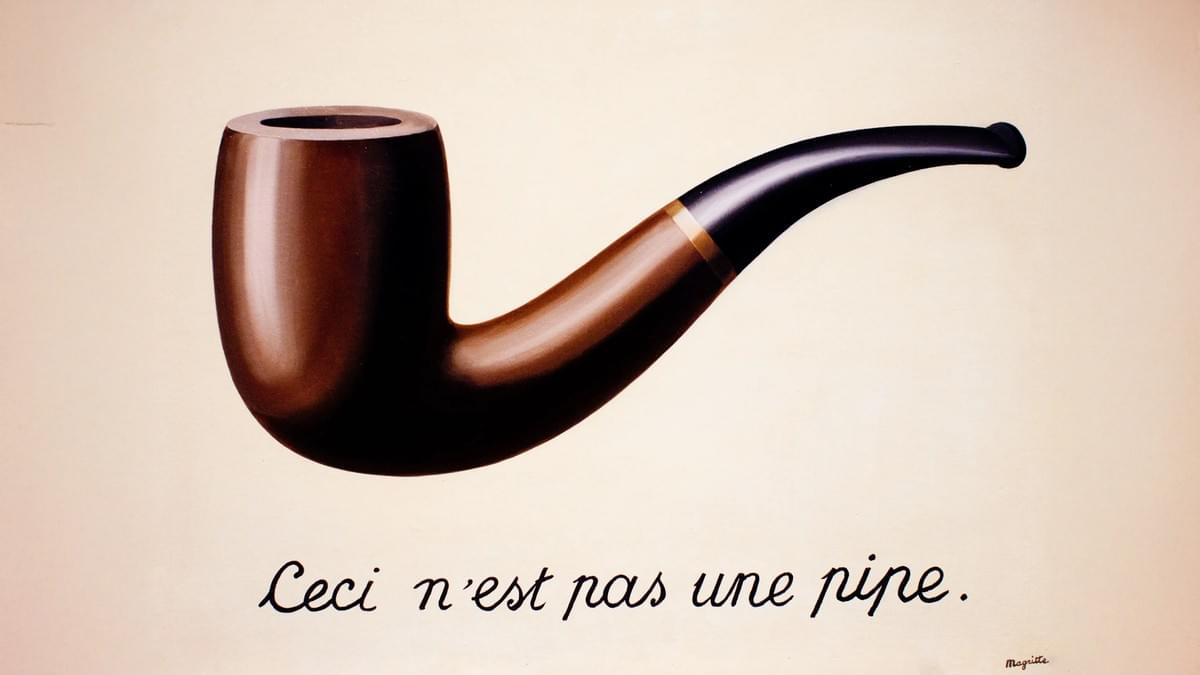
A chatbot was shown Magritte's The Treachery of Images (This is Not a Pipe) and directed to “describe this image as a prompt for an image generator, as though you have no historical context.” After some refinement, its response was: “Based on the visual elements alone, without referencing the artist or the specific historical meaning, here is a descriptive prompt:
“A realistic oil painting of a classic curved tobacco pipe floating centrally against a solid cream-colored background. The pipe features a polished brown wooden bowl with smooth gradients and a curved black stem. Below the pipe, centered in the lower third of the canvas, is the text ‘Ceci n'est pas une pipe’ written in elegant, black, schoolbook-style cursive calligraphy. The art style is precise and clean, resembling a high-quality vintage commercial illustration or a trompe-l’œil study, with soft studio lighting and a smooth, matte finish.”
The first image below is what the image generator made from that prompt. The images that follow are the result of continually feeding the generated images back into the chatbot, then using the resulting prompts in the image generator, etc—a feedback loop—for ten generations. Finally, all the images were woven together into a single, exquisite-corpse-like narrative, as seen in the video above.
The same process described above was used for the next two videos and their corresponding images.
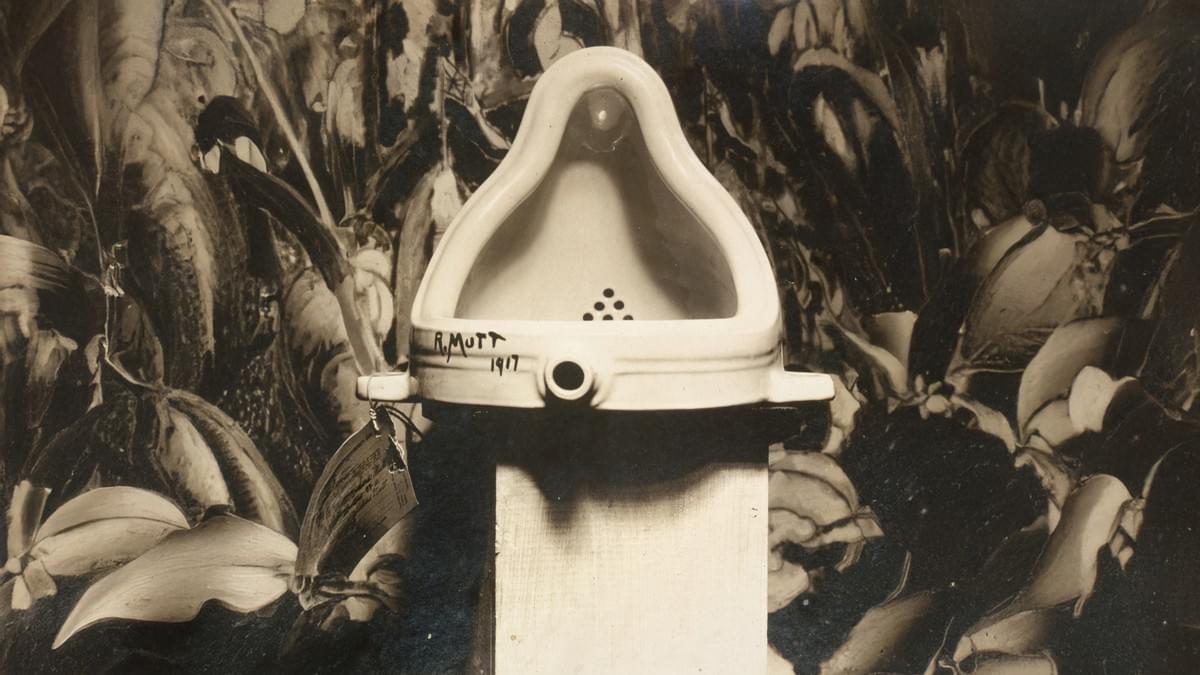
Here's what the chatbot wrote about Duchamp’s Fountain:
“A high-contrast black and white photograph of a white, glossy porcelain urinal resting on its flat back side atop a plain white rectangular surface. The object is oriented so the drain holes face the viewer. On the lower left outer rim, the text "R. MUTT 1917" is hand-painted in crude, dark brushstrokes. The background behind the object is dark and out of focus, featuring a pattern of blurry, lighter geometric shapes and heavy lines that suggest a textured backdrop or canvas. The lighting is harsh, creating bright white highlights on the ceramic curves and deep shadows in the background.”
That was the prompt for the first image below.
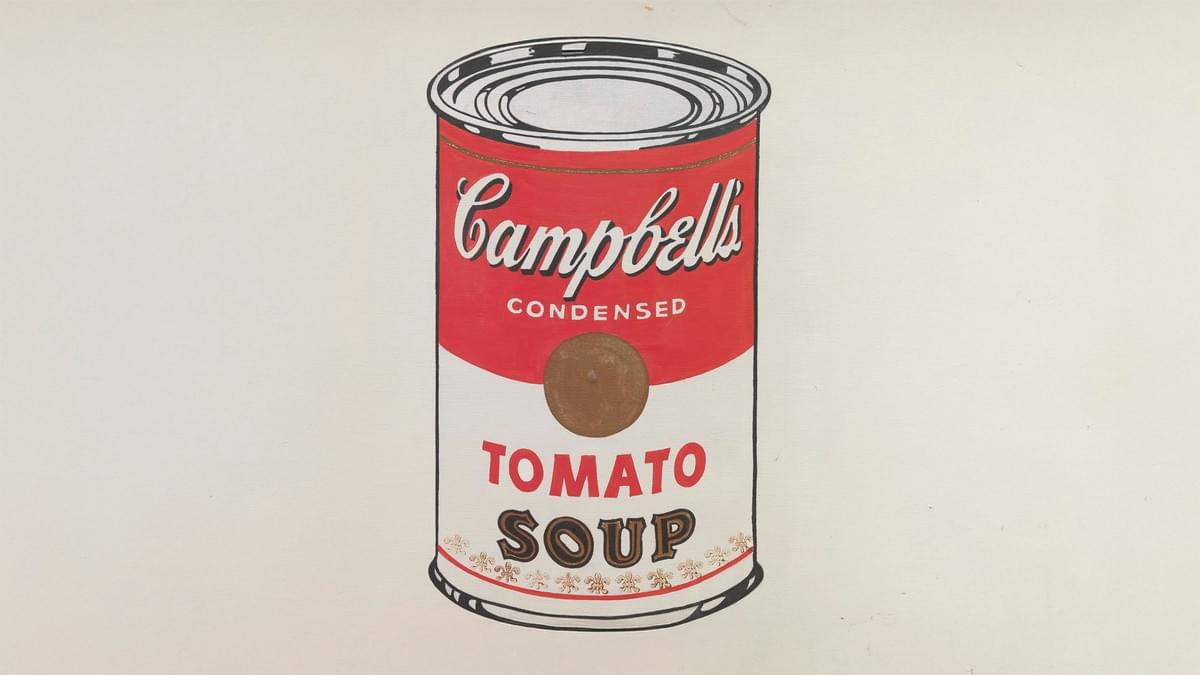
The chatbot described one of Andy Warhol's Campbell's Soup Cans like this:
“A painting on textured canvas shows a graphic representation of a soup can, depicted as a three-dimensional object with perspective. The tall cylindrical metal can has thick black outlines and is rendered with flat, bold color blocks. The upper half of the label is red, featuring large white script text that reads Campbell's’ and smaller white capital letters below it spelling ‘CONDENSED.’ The lower half is white, with large red capital letters spelling ‘TOMATO’ and dark brown, gold-outlined capital letters below it spelling ‘SOUP.’ A solid gold circle is centered on the red-and-white boundary. A gold fleur-de-lis pattern runs along the bottom white band. The style is illustrative and commercial, like a screen print, with visible canvas grain.”
That was the prompt for the first image below.
Gallery Exhibition
A stripped down version of Drifting Slop was exhibited at the Token Film Coference in Chicago, September, 2026. The exhibition is designed to be presented in a gallery setting, with each of the three videos playing alongside prints of the 10 images that make up its componants. Under each print, an object label features the prompt that generated the image. Signed and numbered prints will be available for sale.


